.png)
_edited.png)
.png)
.png)

.png)
.png)
Do artists need to suffer to create something beautiful, or, have we simply grown accustomed to that narrative? The cultural link between depression and creativity reveals more about how society romanticises pain than about how art is actually created.
Vincent van Gogh painted the world with such vibrancy yet struggled with what many now believe was bipolar disorder. Sylvia Plath’s poetry frequently returned to themes of death and identity. Together, they illustrate how the narrative of the ‘tortured artist’ persists.
The concept of the ‘tortured artist’ first gained traction during the Victorian Romantic period, when illnesses such as cholera and tuberculosis cast a shadow over a flourishing artistic movement. Percy Bysshe Shelley radicalised poetry through his explorations of humanity and nature. In his lifetime, he was labelled “mad Shelley” for his emotional outbursts and erratic behaviour. Similarly, John Keats, another defining poet of the era, drew on what he described as his “negative capability” - often interpreted as his way of confronting personal trauma - both as a poetic device and a form of emotional processing.
But this association may not be purely romantic or artistic in origin. Victoria Tischler, a psychologist and honorary professor at the University of West London, has suggested that the link between creativity and emotional suffering may be influenced by financial pressures, with those in creative industries often working longer hours for lower pay. In 2019, Consultancy.uk wrote the following:
"The UK’s creative sector is worth over £100 billion to the UK economy. According to a new study, despite that, most jobs in the sector earn beneath the average annual salary of roles outside the sector."
"According to the study, 58% of creative roles receive a salary of less than £35,058."
Tischler’s observation remains relevant today, with many celebrated artists achieving fame while struggling financially. Edgar Allan Poe, the iconic Gothic writer who revolutionised literature, experienced some celebrity in his lifetime but was still known as “Poor Eddy”, a writer who never escaped poverty. Even after the enduring success of The Raven, he reportedly earned just $9 for the now-classic poem.
"I have no money. I am as poor now as I ever was in my life - except in hope, which is by no means bankable."
- Edgar Allan Poe
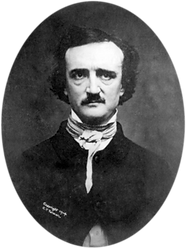
Like many creatives, Edgar Allan Poe’s struggles with his mental health are well documented, reflected in his admission: “I remained too much inside my head and ended up losing my mind.”
Other notable figures who may also be considered in relation to Tischler’s theory include Vincent van Gogh, the Brontë sisters, John Keats and Johannes Vermeer.
While financial instability may contribute to some artists’ mental health struggles, it is not a universal factor. Society’s understanding of bipolar disorder has evolved: what was once mischaracterised as demonic possession or a moral failing is now recognised as a complex mental health condition. Today, researchers note that certain aspects of the disorder, including accelerated thinking, heightened perception, and intensified ideation, may, in some cases, enhance creative output. One study, published in the Journal of Personality and Social Psychology, found that individuals with high creative achievement were more likely to experience the disorder.
Some scholars now suggest that the renowned composer Ludwig van Beethoven may have been bipolar. He is documented as experiencing extreme mood swings, and it was often during these intense periods that his creativity flourished. Johann Wolfgang von Goethe, who met Beethoven in 1812, wrote: “[His] talent amazed me. However, he is an utterly untamed personality.” This example illustrates how periods of emotional intensity can coincide with creative breakthroughs, though suffering itself is not a prerequisite for genius.
In 2017, psychiatrist Gail Saltz summarised the idea that increased creativity may be more common among neurodivergent individuals due to their “wavering attention and daydreaming tendencies,” which, she continued, can be “a source of highly original thinking […] Their creativity, out-of-the-box thinking, high energy levels, and disinhibited manner could all be a positive result.” While neurodivergent traits may sometimes feel distressing, they can also enhance comprehension and focus. At the same time, the intensity of such traits can bring challenges, including anxiety and OCD. These observations suggest that characteristics often perceived as difficulties may simultaneously foster originality and creative insight.
The connection between artistry and emotional suffering is not purely historical. Even in today’s more aware world, artists struggling with mental health often channel their experiences into their work. The late singer Amy Winehouse was open about her struggles with depression, bulimia, and bipolar disorder, which coincided with her challenges with alcoholism. In 2007, she told Rolling Stone: “I do suffer from depression, I suppose. Which isn't that unusual.” Her music often reflected this intensity, illustrating how personal suffering can inform artistic expression.
"[Winehouse was] darkly depressed and felt isolated, though family and friends say they tried to reach her. On the other hand, those around her were willing to help turn her resistance to rehab into a financially profitable pop tune. Lucre for them on the back of her suffering, though she was a willing partner in this public display of self-harm.
"Denial is an important [defence] and part of good mental health when it gives us time to adjust to distressing situations. Soldiers in Ukraine today need to deny the realities surrounding them in order not to be overwhelmed and to continue protecting their country and families. Many of us have had the experience, following a loved one’s death, of knowing they are gone but not fully believing it."
- Timmen L. Cermak MD
In conclusion, creativity and mental health are deeply intertwined, with many artists’ unique sensitivities shaping how they perceive and interpret the world through their work. While emotional struggles may influence artistic expression, they are neither a prerequisite nor a guarantee of creativity. From historical figures like Van Gogh and Keats to modern artists such as Amy Winehouse, it is clear that the interplay between mind and art is complex, and that creativity often thrives in the full spectrum of human experience, not only in suffering.
Vincent van Gogh’s struggles are well-documented, yet his unique perspective shines vividly through his art. Despite periods of profound darkness and social isolation, his paintings radiate colour, light, and, perhaps, hope — a testament to how emotional sensitivity can shape creative vision without defining it entirely.
For many artists, their work is shaped by a combination of brilliance and personal pain. Sylvia Plath’s 1963 novel, The Bell Jar, is celebrated as a cornerstone of feminist literature, praised for its vulnerability and emotional honesty. Much of the novel’s anguish mirrors Plath’s own experiences, making it widely regarded as semi-autobiographical. Her example illustrates how, for some creatives, personal suffering can become inseparable from artistic expression.