.png)
_edited.png)
.png)
.png)

.png)
.png)
%20(10.png)
%20(2).png)
To many, she is the epitome of a man’s desires and a woman’s ideals: a blonde bombshell wrapped in a cocktail gown, with an allure that is both naïve and knowing, and a manner that is almost infantilising—yet so seductive.
But behind the name of Marilyn Monroe was simply Norma Jeane Mortenson: a vulnerable girl who only ever wanted to be truly loved. That girl behind the red lipstick is now remembered more as a brand than a woman.
To understand the immense popularity of the character, and the revolution she caused in Hollywood, you have to understand the tragedy of the icon.


Norma never knew true stability in her youth. Her mother, Gladys, struggled immensely with her mental health and lived most of the time under financial strain. Growing up, the future Hollywood star would dream about her father—a man whose identity she never knew. To her, maybe Marilyn saw her father as an escape from the uncertainty and unpredictability of Gladys. But the absence of a father figure undoubtedly shaped her relationship with men—her idea of romance seemed to rely heavily on the promise of security.
She would later say:
“Most people can admire their fathers, but I never had one. I need someone to admire. My father is Abraham Lincoln... I mean, I think of Lincoln as my father. He was wise and kind and good. He is my ideal, Lincoln. I love him.”
Gladys had periods of normality, but like her daughter, she too was emotionally hurting. When Norma was seven years old, her mother was diagnosed with paranoid schizophrenia and remained institutionalised for most of the rest of her life.
For the next sixteen months, it is believed Norma Jeane was sexually abused by her foster family, the Atkinsons. She became withdrawn and shy and developed a stutter during this time. Tragically, this stutter would later become a characteristic fetishised by Hollywood in its sexualisation of her.
In 1942, at 16 years old, Norma married her neighbour James Dougherty—not out of love, but to avoid returning to yet another orphanage or foster home. Her marriage was a desperate attempt to gain control.
During the Second World War, Dougherty was drafted abroad, and Norma Jeane began work in a local factory. She was known for her beauty—a shy, simple sort of grace with her curled brown hair and baby face. During a tour of American factories to photograph female workers to boost soldiers' morale, photographer David Conover came across the now 19-year-old Norma. Although he never used any of the photographs he took of her, he instilled in her the dream that she could escape her life and become a model.
The birth of "Marilyn Monroe" followed shortly after—a name combining Broadway star Marilyn Miller and Gladys’s maiden name, Monroe. Her adulthood was as distressing as her childhood, with two more failed marriages, inescapable depression, and at least three miscarriages.
On August 5, 1962, the body of Norma Jeane was discovered in her bed, hand wrapped around the telephone cord. Several medication bottles surrounded her body, with more littered across the bedroom. Yet all the press cared about was that she had died in the nude.
At 36 years old, the starlet died of a drug overdose.
During her life and since her death over 60 years ago, Hollywood has frantically searched for someone to carry on the “character” created in Marilyn Monroe. Ironically, everyone wants to be Marilyn Monroe, but Marilyn Monroe only ever wanted to be Norma Jeane.
“I've never fooled anyone. I've let people fool themselves. They didn't bother to find out who and what I was. Instead, they would invent a character for me. I wouldn't argue with them. They were obviously loving somebody I wasn't.”
.png)
Blonde bombshell Jayne Mansfield was undoubtedly Hollywood’s first attempt to manufacture a “Marilyn-like” actress. Starting out as a beauty contestant and Playboy model under Hugh Hefner, Mansfield turned her attention to film in 1954, doing screen tests for both Warner Bros. and Paramount. Like Marilyn, she had ambitions of being a serious dramatic actress, but due to her sexualisation, studios encouraged her to embrace her “natural talents”—in other words, play roles that relied on her looks rather than her acting skill. She was told to dye her naturally brunette hair to Marilyn's bleach blonde.
Unlike the more publicly reserved Monroe, Mansfield was a loud personality who demanded attention. In 1955, for a film event, she infamously wore a bikini far too small for her figure, and when she jumped into a pool, she lost her top—creating a media frenzy.
That same year, she made her Broadway debut in Will Success Spoil Rock Hunter? Her role as Rita Marlowe was a clear parody of Monroe—whose earlier work The Seven Year Itch had been adapted by the same writer, George Axelrod.
During a 1956 dispute between Monroe and Fox Studios, which saw the actress temporarily abandon Hollywood, Mansfield was promoted into Marilyn’s typical “dumb blonde” roles.
Like Monroe, Mansfield also died young. In 1967, she died in New Orleans when the car she was in collided with the back of a truck.

.png)
“Hollywood didn’t want to be reminded of blondes at that time, which was also one of the reasons why they didn’t want me anymore. [...]
"Marilyn was being used, she knew that and she was trying to cope with it. And the drugs made things much, much worse. It exaggerated everything. She was so vulnerable to the world, but what a sweet person she really was—lovable, compassionate—I have nothing but grace for Marilyn.
"In films, [Mansfield] played mostly character roles, while Marilyn did more sophisticated movies, and I did several rock ‘n’ roll movies. The three of us were often compared, maybe because we had blonde hair, but all three of us were very different.”
At the height of Marilyn’s rise in 1953, blonde newcomer Mamie Van Doren signed a seven-year contract with Universal, which hoped she would be their answer to Monroe. Like both Monroe and Mansfield, Doren became an instant Hollywood bombshell. Producer Howard Hughes famously asked her, “Are you a virgin?” during their first encounter.
To perfect that “Marilyn” character, Doren was coached by Monroe’s former drama teacher and friend, Natasha Lytess. Through Lytess, the two women met. Unlike Monroe, Doren wasn’t cast as the “dumb blonde,” instead playing more nuanced teenage roles.
Though comparisons were inevitable, Doren insisted there was no rivalry, and the two maintained a civil celebrity relationship.
When Monroe and Mansfield died, Doren noted how Hollywood quickly wanted to forget the archetype they once idolised.

.png)
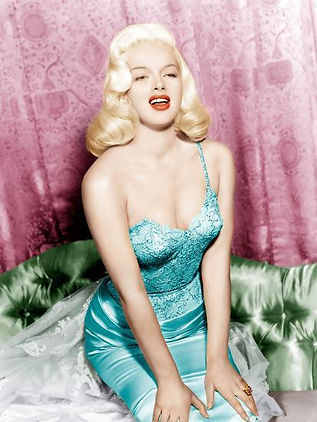
Diana Dors was England's answer to the Marilyn craze. She was bold with a noir appeal, and a known reputation as a ‘bad girl’ which was echoed in her film roles. Unlike Monroe, she was unreserved in many ways, embracing her sexuality publically and proudly but in a way which was uncaring yet natural.
Dors knew what her celebrity rooted in, and although she enjoyed the stardom, she did not want to be just “England’s Marilyn Monroe.”
“I don’t want to sort of be a carbon copy of Marilyn. I want to be England’s Diana Dors.”
She was known for her excentric lifestyle with her name often being associated with partying, sex and crime - with her notoriously being friends with the gangster Kray brothers and Ruth Ellis, the last woman to be executed in England.
She too died young, passing of ovarian cancer at the age of 52.
Marilyn’s influence among 21st-century stars was perhaps most evident in model and Playboy Bunny Anna Nicole Smith. Where others mimicked Monroe’s image, Smith was a genuine fan—seeing her not as an act to replicate, but as an inspiration.
“[I’m] never better than Marilyn.”
Smith became obsessed with Monroe at age five and often told people she wanted to be like her. The comparison is tragic, considering the shared struggles: intense media scrutiny, teenage marriages to escape hardship, and deep childhood poverty. Monroe's influence extended far—Smith rented her former home and would perform Diamonds Are a Girl’s Best Friend to calm her nerves.
Like Monroe, Smith died tragically young of a drug overdose at the age of 39.
“I just feel a connection with Marilyn Monroe. I just love her. I just completely feel what she went through.”


Although Marilyn Monroe died over 60 years ago, as Elton John said,
“[Her] candle burnt out long before, her legend ever did.”
The mark that Norma Jeane left on Hollywood—and on the world—is indescribable. She remains the subject of films, music, and fashion.
Every girl may wish to be Marilyn Monroe growing up, but as adults, more of us relate to Norma Jeane Mortenson. All these years later, the star is loved not just for her beauty and wit, but for her vulnerability—something many see in themselves. She was authentic, and it is ironic that Hollywood has tried so desperately to replicate her. Perhaps they never understood what made her truly special. And maybe that’s why, 63 years later, there has still never been another star quite like Marilyn Monroe.
