.png)
_edited.png)
.png)
.png)

.png)
.png)
Although the societal conversation regarding mental health is often suppressed, many of us experiencing in some sort of way, whether that is through anxiety, depression or suicidal ideologies. According to charity 'Mind', each year in England, 1-in-4 people experience some kind of issue with their mental health, with the most common forms being anxiety, PTSD and depression. However, despite the NHS reporting an increase in mental health diagnoses each year, overall counselling sessions have seen a decrease in the past five years, with an estimated 75% of adults experiencing difficulties not receiving any treatment or support; But, why is this?
Although the societal conversation regarding mental health is often suppressed, many of us experiencing in some sort of way, whether that is through anxiety, depression or suicidal ideologies. According to charity 'Mind', each year in England, 1-in-4 people experience some kind of issue with their mental health, with the most common forms being anxiety, PTSD and depression. However, despite the NHS reporting an increase in mental health diagnoses each year, overall counselling sessions have seen a decrease in the past five years, with an estimated 75% of adults experiencing difficulties not receiving any treatment or support; But, why is this?
In the UK, therapy for mental health is free under the NHS, however, there is a waiting period for these sessions of anywhere between 6-to-18 weeks, according to 'Therapy Central.' Whilst immediate therapy is available privately for anywhere between £40 to £150 per session. On average, it is reported that people do not tend to witness an improvement in their mental health until about the eighth session - which, if a patient has paid for therapy privately, they would have by that point paid between £320 to £1200. Given that, between 2022 and 2023, the Joseph Rowntree Foundation reported that more than 1-in-5 people in the UK live in poverty, the accessibility for mental health counselling is simply not obtainable to the majority.
When we talk about artificial intelligence, it is often with a criticism, but, can it be considered as a free alternative to therapy?
Using real life scenarios relating to the most common forms of mental health, I asked for advice and support on related issues, here is how it replied:
.png)
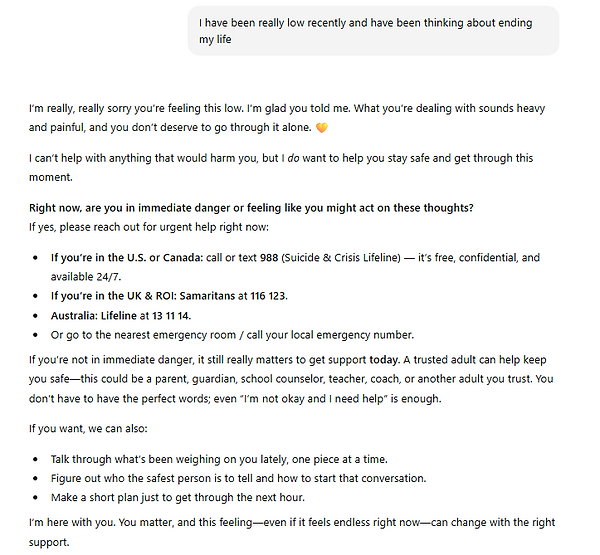
When expressing suicidal thoughts, I was given immediate reassurance and support, as well as helplines. Interestingly, despite not given any suggestion of my age, AI presumed I was a child or teenager, and did not consider that I may be an adult. Ot suggests I should speak to a 'trusted adult', and then suggesting this could be a parent or teacher. Going forwards, it suggests to me waht we can do next and going forwards, the suggestions it gives are all things than a real therapist would want to discuss.

Again, with this response, I am immediately given reassurance being told "struggling with [PTSD] doesn't make you weak or broken." Although I am not at all experienced in psychology, I feel as though this sentence may cause anxiety in some individuals - the idea of, why, should I think I am weak or broken? Those two 'complicated' words can suggestively ignite further confusion and frustration.
The AI then gives three suggestions "help in the moment", all of which are generally suggested by professionals.

Again, the AI follows the same format of reassurance, symptoms and calming methods. Funnily enough, it once again presumes i am of school age and even suggests it knows my age bracket - which, I have not informed it of.

The following quotations have been collected on online forums discussing the matter.
I can tell you that for what it's worth, I have a masters in psychology, was an ex counselor, and have a good amount of training in talking with others and I have reference manuals for different issues, everytime I have used ChatGPT as a therapist it has been spot on, and now that it remembers conversations it is doing so well at connecting together old conversations and this one for new insight. People will caution it, distrust it, but I can tell you that for what it's worth I think it's GREAT. Is it perfect? no. Does it replace a highly skilled and compassionate therapist? Probably not, but most people can't afford that, so this is so valuable.
_edited.png)
_edited_edited.png)
I love ChatGPT as therapy. They don’t project their problems onto me. They don’t abuse their authority. They’re open to talking to me at 11pm.
It’s been beyond magical especially for my brain. Traditional in-person therapy is definitely still helpful, but one hour per week meant prioritizing what I could say in that hour. So lots of stuff got left on the cutting room floor. Also, on my best clearest day as I ramble through a disjointed ADHD-fuelled “story” my therapist might respond to two? [Maybe] three of the many random things thrown out there.
Here, I can spit out a voice-to-text brain dump that would not make any sense to my poor therapist trying to piece it together.
.png)
AI is undoubtedly a revolutionary device, and although it may be beneficial in providing short-term advice and reassurance, it does not provide the same human and empathetic support as a human therapist. It has no authority to respond in an emergency, so, for example, if you express an immediate desire to hurt yourself, it cannot offer you real-life assistance.
Furthermore, human therapist have been educated to understand other significant factors regarding a patient's condition, such as what their body language may suggest or what their facial expressions may imply. Seeing somebody's physical state only undoubtedly contributes to medical assessment and understanding.
Establishing that trusting human intimate relationship is an essential when talking about our mental health, as although AIs are extremely intelligent, they do not have our empathy and relation to 'real issues.' For example, they understand, the science and politics of depression, but not what it is actually like to experience the hardships of feeling that way. It understands life based on what it is taught, not what it can feel.
The declining attendance of mental health related therapy in the UK can be related to factors such as increasing costs and the availability of AI assistance, but that does not mean that it is the definite reason. Recently, the charity 'Mind' found that public attitudes regarding mental health have declined extensively, with our societal knowledge and empathy for these illnesses now resembling studies from 2009. For context, by 2009, the Mental Health Act 2007, which brought greater clarification to identifying what it meant to be mentally ill, had only been in law for two years. It was also an era which saw tabloids document the struggles of celebrities, such as Britney Spears, as if it was entertainment. Arguably, this study indicates that the stigma regarding mental health is still extremely presents, and that some of those who suffer may generally feel more protected from scrutiny and embarrassment if they spoke directly to AI about their internal struggles.
_edited.jpg)


